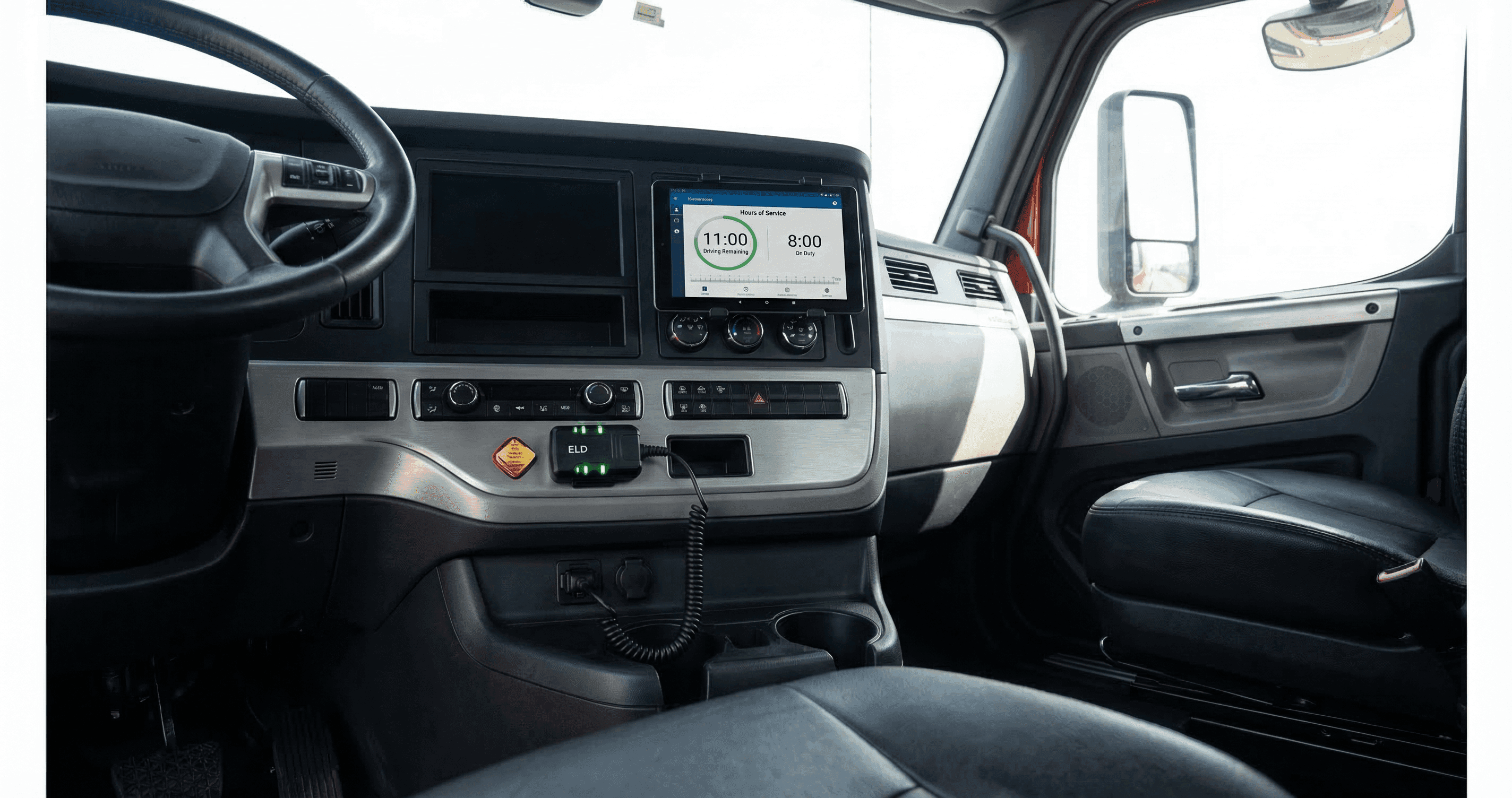
What Is an ELD? The Complete Guide to Electronic Logging Devices in 2026
Everything fleet owners and truck drivers need to know about ELDs — how they work, who needs one, and how to choose the right device for your operation.
What Is an ELD?
An Electronic Logging Device (ELD) is a piece of hardware that connects to a commercial motor vehicle's engine and automatically records driving time and hours of service (HOS) data. ELDs replaced paper logbooks as the mandatory method for tracking driver duty status under the FMCSA's ELD mandate, which took full effect in December 2019.
In simple terms, an ELD plugs into your truck's diagnostic port (OBD-II or RP1226), pairs with a driver's smartphone or tablet via an app, and automatically logs when you're driving, on duty, in the sleeper berth, or off duty. No more paper. No more guessing. No more manual calculations.
How Does an ELD Work?
Here's what happens under the hood:
-
Engine connection: The ELD hardware connects to your truck's ECM (Engine Control Module) through the diagnostic port. This gives it direct access to engine data — RPM, vehicle speed, miles driven, and engine hours.
-
Automatic recording: When the vehicle is moving, the ELD automatically records driving time. There's no "start" button to press. If the wheels are turning and the engine is running, it's logging.
-
Driver app interface: Drivers interact with the ELD through a mobile app on their phone or tablet. They can view their current HOS status, switch duty status (on-duty not driving, sleeper berth, off duty), add annotations, and certify their logs.
-
Data transmission: ELD data can be transferred to law enforcement during roadside inspections via Bluetooth, email, or web services. Fleet managers can access driver logs in real-time through a web dashboard.
-
Tamper-resistant: ELDs are designed to prevent data manipulation. Edits to records are tracked with annotations, and original entries are always preserved.
ELD vs. AOBRD vs. Paper Logs
Before the ELD mandate, many carriers used AOBRDs (Automatic On-Board Recording Devices) — an older generation of electronic logs. Here's how they compare:
| Feature | Paper Logs | AOBRD | ELD |
|---|---|---|---|
| Recording method | Manual | Semi-automatic | Fully automatic |
| Engine connection | None | Optional | Required |
| Tamper resistance | None | Limited | Built-in |
| FMCSA compliant (2026) | ❌ No | ❌ No (grandfathered until 2019) | ✅ Yes |
| Data transfer to DOT | Paper handoff | Various | Standardized |
| Cost | ~$0 | Varies | $15-50/month |
Bottom line: As of 2026, AOBRDs are no longer compliant. If you're operating a CMV that requires HOS tracking, you need a registered ELD.
Who Needs an ELD?
Under FMCSA regulations (49 CFR Part 395), most commercial motor vehicle drivers who are required to keep Records of Duty Status (RODS) must use an ELD. This includes:
- Interstate carriers operating vehicles with a GVWR over 10,001 lbs
- Vehicles transporting hazardous materials requiring placards
- Passenger-carrying vehicles designed to transport 9+ passengers for compensation or 16+ passengers regardless of compensation
Who Is Exempt from the ELD Mandate?
Not every truck on the road needs an ELD. FMCSA provides several exemptions:
- Short-haul drivers operating within a 150 air-mile radius who don't keep RODS (use timecards instead)
- Driveaway-towaway operations where the vehicle being driven is the commodity
- Vehicles manufactured before model year 2000 (no standardized diagnostic port)
- Drivers who use paper RODS no more than 8 days in any 30-day period
- Agricultural operations during planting and harvesting seasons (within 150 air-mile radius)
Pro tip: Even if you qualify for an exemption, using an ELD can still save you time and reduce compliance headaches during inspections. Many owner-operators voluntarily adopt ELDs for the operational benefits.
For a detailed breakdown, read our complete guide to ELD exemptions.
The ELD Mandate: A Brief History
The push for electronic logging didn't happen overnight:
| Year | Event |
|---|---|
| 2010 | Congress mandates FMCSA to develop ELD rules (MAP-21 Act) |
| 2015 | Final ELD rule published (49 CFR Part 395) |
| Dec 2017 | Compliance phase begins — carriers must use ELDs or AOBRDs |
| Dec 2019 | Full enforcement — AOBRDs no longer accepted; all must use registered ELDs |
| 2025 | FMCSA proposes updated ELD rules with stricter certification and data security |
| 2026 | Updated ELD regulations expected to take effect |
What Happens If You Don't Have an ELD?
If you're required to have an ELD and don't:
- Roadside inspection: Your vehicle will be placed out of service for 24 hours. That's a full day of lost revenue.
- CSA score impact: ELD violations affect your Safety Measurement System (SMS) results, potentially triggering FMCSA interventions.
- Fines: Penalties range from $1,000 to $16,000 per violation depending on severity and history.
- Insurance costs: Poor CSA scores lead to higher insurance premiums.
How to Choose the Right ELD
Not all ELDs are created equal. Here's what to evaluate:
1. FMCSA Registration
First things first — verify the device is on the FMCSA's registered ELD list. There are over 900 registered devices, but registration doesn't mean FMCSA has tested or certified the device. It means the manufacturer self-certifies compliance.
What to look for: Choose a provider with a track record, real customer reviews, and responsive support. A cheap ELD that fails during an inspection costs more than a quality one.
2. Hardware Quality
The hardware matters more than most people think:
- Connection type: OBD-II (most common for light/medium trucks) or RP1226/J1939 (heavy-duty trucks)
- Durability: Will it survive vibration, temperature extremes, and dust?
- Power consumption: Some devices drain the battery when the truck is parked
- Installation: Plug-and-play vs. hardwired
FIRST ELD's PT30 device connects via the diagnostic port with true plug-and-play installation — no wiring, no drilling, no mechanic needed. It's designed for the harsh trucking environment and maintains connection stability even on rough roads.
3. Driver App Experience
Your drivers will use the app every single day. If it's frustrating, they'll fight it.
- Simplicity: Can a new driver figure it out without a training session?
- Speed: Does it load fast and respond quickly?
- Offline capability: Does it work in areas without cell signal?
- Language support: Multi-language support matters for diverse fleets
FIRST ELD's driver app is rated 4.9 stars and supports English, Spanish, Russian, Ukrainian, and Uzbek — no training needed.
4. Fleet Dashboard & Reporting
For fleet managers, the dashboard is where you live:
- Real-time HOS visibility for every driver
- Violation alerts before they happen
- DVIR (Driver Vehicle Inspection Reports) management
- IFTA fuel tax reporting automation
- GPS tracking and geofencing
5. Pricing & Total Cost
ELD pricing typically includes:
- Hardware: $50-300 one-time (some providers offer "free" hardware with contracts)
- Monthly subscription: $15-50/driver/month
- Activation fees: $0-100
- Cancellation fees: Watch out for long-term contracts
FIRST ELD pricing starts at competitive rates with no long-term contracts. See current pricing →
6. Customer Support
When something goes wrong at 2 AM in a truck stop in Nebraska, can you actually reach someone?
- 24/7 availability is non-negotiable
- Phone support (not just email tickets)
- Multi-language support for diverse driver pools
- Average response time — ask before you buy
FIRST ELD offers 24/7 support via phone at (645) 202-0550 in English, Spanish, Russian, Ukrainian, and Uzbek.
ELD Features Beyond Basic Compliance
Modern ELDs do much more than just log hours. Here's what leading platforms offer:
GPS Fleet Tracking
Real-time location of every vehicle in your fleet. Know where your trucks are, where they've been, and when they'll arrive.
AI-Powered Dashcams
Integrated camera systems that detect unsafe driving behaviors — distracted driving, following too closely, hard braking — and alert managers in real-time.
Vehicle Diagnostics
Engine fault code monitoring and predictive maintenance alerts. Know about problems before they strand your driver.
Geofencing
Set virtual boundaries around customer sites, yards, and distribution centers. Get automatic notifications when trucks arrive or depart.
IFTA Reporting
Automatic fuel tax calculations by jurisdiction. No more manual mileage logs for quarterly IFTA filings.
DVIR (Digital Vehicle Inspections)
Replace paper pre-trip and post-trip inspection forms with digital DVIRs — complete with photos and mechanic sign-off workflows.
Frequently Asked Questions
How much does an ELD cost?
ELD costs typically range from $15-50/month per driver plus hardware costs of $50-300. Some providers bundle hardware with subscription plans. See our complete ELD pricing guide →
Can I use my phone as an ELD?
Your phone runs the ELD app, but you still need the hardware device that connects to your truck's engine. The phone alone can't read engine data — it communicates with the ELD hardware via Bluetooth.
How long do ELD records need to be kept?
FMCSA requires carriers to retain ELD records for a minimum of 6 months. Most ELD providers store data in the cloud, making this automatic.
What's the penalty for not having an ELD?
Drivers found without a required ELD during a roadside inspection will be placed out of service for 24 hours. Fines range from $1,000 to $16,000 per violation.
Can my ELD be used against me?
ELD data can be requested during investigations and litigation. However, accurate ELD records are actually your best defense — they prove compliance and protect against false claims about driving time.
Do owner-operators need an ELD?
Yes, if you operate a CMV that requires HOS record-keeping and don't qualify for an exemption. Most owner-operators running interstate need an ELD.
What happens during a roadside inspection with an ELD?
The inspector asks to see your ELD display. You switch to "roadside inspection" mode, which shows your current day's log and the previous 7 days. Data can be transferred to the inspector via Bluetooth, email, or web services.
Why Fleets Choose FIRST ELD
FIRST ELD delivers everything your fleet needs in one platform:
- ✅ FMCSA-registered and fully compliant
- ✅ PT30 hardware — plug-and-play, no installation costs
- ✅ 4.9-star driver app — simple, fast, works offline
- ✅ Real-time fleet dashboard — HOS, GPS, diagnostics, DVIR
- ✅ 24/7 multilingual support — English, Spanish, Russian, Ukrainian, Uzbek
- ✅ No long-term contracts — month-to-month flexibility
- ✅ AI dashcam integration — optional video-based safety
Ready to see it in action? Schedule a demo → or call (645) 202-0550.
Last updated: March 2026
Related articles: